
An IPO is a process where a company sells its shares to the public in exchange for capital. Through this, a company moves from being privately owned to publicly owned, and people like us become investors in that company. This allows investors to participate in the company’s growth and potentially earn returns on their investment. In simple terms, an IPO connects companies that need funds with investors who want to grow their money.
Investing in an IPO can be a smart move when it is based on proper information and understanding. It offers potential benefits, but it also involves risks. That is why, before investing in any IPO, it is important to understand the basics, analyse the company, and make decisions carefully instead of following hype.
What is an initial public offering (IPO)
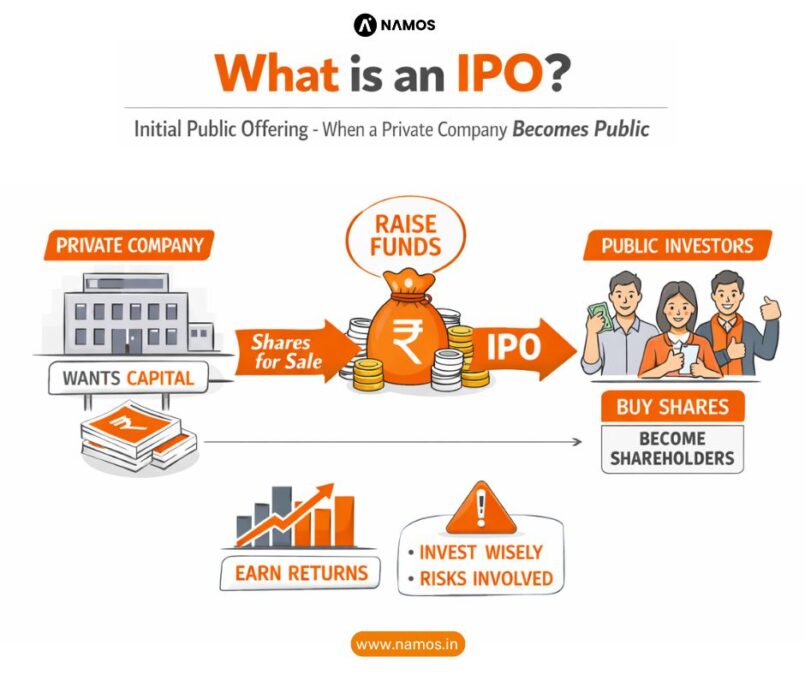
An IPO (Initial Public Offering) is the process through which a private company becomes a public company by offering its shares to the general public for the first time. In simple terms, when a company needs money for growth, expansion, or other business purposes, instead of taking a loan, it raises funds from the public by selling its shares. In return, investors get ownership in the company in the form of shares. This is what we mean by What is an IPO in the Stock Market.
The IPO process starts when a company plans to go public and files its documents with the Securities and Exchange Board of India (SEBI) for approval. After getting approval, the company decides a price band for its shares and opens the IPO for a limited period, where investors can apply. Based on demand, shares are allotted to investors, and finally, the company gets listed on the stock exchange, where trading starts and share prices move according to market demand and supply.
Investing in an IPO can be a good opportunity because it allows investors to enter a company at an early stage and potentially earn returns if the company performs well. However, it is important to understand that IPOs also involve risks, as there is no guarantee that the stock will perform well after listing. That is why investors should always check the company’s financials, business model, and purpose of raising funds before investing, instead of blindly following market hype.
Types of IPO in India
There are mainly Two Types of IPO in the stock market.
- Fixed Price IPO is where the company decides a fixed price for its shares in advance, and investors apply at that price. In this case, you already know the exact price you are paying, but the demand is known only after the IPO closes.
- Book Building IPO is more common today. In this method, the company gives a price band (for example, ₹100–₹120), and investors can bid within this range. The final price is decided based on demand, which makes it more market-driven and transparent.
Benefits of Investing in an IPO
- Diversification Opportunity
IPOs allow you to invest in new companies and sectors, helping you diversify your portfolio. - Capital Appreciation
If the company performs well, the share price can increase over time, giving good returns. - Early Investment Opportunity
You get a chance to invest in a company at an early stage before it becomes well-known. - Transparency & Regulation
IPOs are regulated by the Securities and Exchange Board of India (SEBI), which ensures proper disclosures and safer investing. - Long-Term Growth Potential
Strong companies can create wealth over time if you stay invested patiently.
Disadvantages of Investing in an IPO
- No Guarantee of Profit
IPOs do not always give listing gains; the price can fall after listing. - High Risk
Since the company is new to the market, performance is uncertain. - Limited Information
Compared to listed companies, there is less historical data to analyse. - Overvaluation Risk
Sometimes IPOs are priced high due to hype, leading to losses. - Market Volatility
Market conditions can affect the listing price and future performance.
How to Invest in an IPO (Step-by-Step)
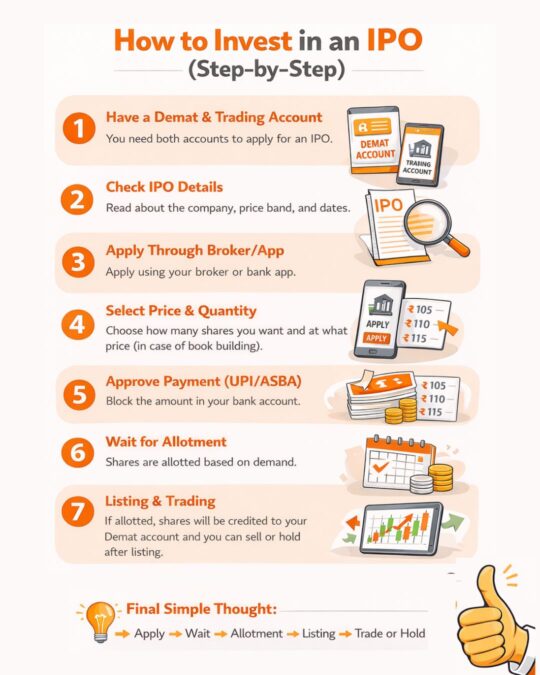
- Have a Demat & Trading Account
You need both accounts to apply for an IPO. - Check IPO Details
Read about the company, price band, and dates. - Check IPO Details
Read about the company, price band, and dates. - Apply Through Broker/App
Apply using your broker or bank app. - Select Price & Quantity
Choose how many shares you want and at what price (if applicable, during book building). - Approve Payment (UPI/ASBA)
Block the amount in your bank account. - Listing & Trading
If allotted, shares will be credited to your Demat account, and you can sell or hold after listing.
Important Terms Associated with IPO
| Term | Meaning |
|---|---|
| IPO (Initial Public Offering) | When a company offers shares to the public for the first time |
| Price Band | The price range (e.g., ₹100–₹120) in which you can apply |
| When shares start trading on the stock exchange | Minimum number of shares you can apply for |
| Issue Price | Final price at which shares are allotted |
| Listing | When shares start trading on stock exchange |
| Listing Gain | When shares start trading on the stock exchange |
| Allotment | Process of distributing shares to investors |
| Oversubscription | When demand is higher than available shares |
| Under-subscription | When demand is lower than available shares |
| ASBA | Amount blocked in your bank account while applying |
| Cut-off Price | Price at which shares are finally allotted (mostly for retail investors) |
| Grey Market Premium (GMP) | Unofficial price before listing (just an indication, not reliable) |
The eligibility criteria for IPO Investment
- Indian Resident
- PAN Card (Mandatory)
- Bank Account – You must have an active bank account for payment (ASBA/UPI).
- Demat Account -Required to receive shares in digital form.
- Trading Account – Needed to apply and later sell shares after listing.
IPO Process Explanation in India
Companies go public for many reasons — to raise funds, expand their business, reduce debt, increase brand value, and create growth opportunities. Instead of taking loans, they choose the stock market to collect money from the public. This entire journey from a private company to a public company is called the IPO process.
- Investment Bankers
The IPO process starts when a company first connects with investment banks (merchant bankers) and appoints them to manage the IPO. These banks do not just handle paperwork—they deeply analyse the company’s financials, business model, and growth potential. They work closely with the company’s management to decide how much money should be raised, what valuation is suitable, and how the IPO should be structured. The banking team studies revenue, profit, debt, and plans, and based on this analysis, they guide the company on pricing, timing, and overall strategy. In simple terms, investment bankers act as the main advisors and coordinators who design and drive the entire IPO process from the beginning.
- Preparing DRHP & RHP with SEBI
After the investment banking part is completed, the next step is to prepare and file important documents with the Securities and Exchange Board of India (SEBI). The company, along with its bankers, prepares the DRHP (Draft Red Herring Prospectus), which includes complete details like financial statements, business model, industry overview, risks, management information, and the purpose of raising funds. This document is submitted to SEBI for review and approval to ensure everything is transparent and follows regulations.
Once SEBI reviews and gives clearance, the company files the RHP (Red Herring Prospectus), which is the final version used for the public issue. This document includes updated details like the price band and issue structure. After this, the IPO is prepared to be offered to the public, where investors can apply during the opening period.
- Apply to the Stock Exchange (Listing Application)
Once all documents are finalised and approved, the company applies to the stock exchanges to list its shares. In India, companies usually choose exchanges like the National Stock Exchange of India (NSE) and the Bombay Stock Exchange (BSE). The company submits a listing application along with all required documents, and the exchange reviews whether the company meets all eligibility criteria, compliance rules, and disclosure standards. After approval from the exchange, the company gets ready for listing, where its shares will be officially available for public trading.
- Roadshows & Marketing
Before the IPO opens to the public, the company and its investment bankers conduct roadshows and marketing activities, which usually last around 1–2 weeks. During this time, the company travels and presents its business to potential investors across different locations. The main goal is to educate investors, build trust, and create demand for the IPO.
Large institutional investors (like mutual funds and big financial institutions) also participate in these meetings, where they analyse the company’s financials, growth potential, and decide how much they want to invest. Based on this interest and demand, the company gets an idea of pricing and subscription levels. In simple terms, roadshows help the company attract investors and ensure a successful IPO before it goes public
- IPO Pricing
IPO pricing is decided by two methods. In the Fixed Price Method, the company sets a fixed price after analysing its business and financials. In the Book Building Method, the company gives a price band (e.g., ₹100–₹120), and the final price depends on investor demand. Usually, the upper price is about 20% higher than the lower price, and the IPO stays open for around 3 days.
GMP (Grey Market Premium) is an unofficial price before listing, showing market sentiment, but it is not reliable.
- IPO Goes Public
Once the IPO opens to the public, investors can apply through brokers or banks during a fixed period, usually 3–5 working days. All details like price band, lot size, and company information are already available, and payments are made through UPI or ASBA, where the amount gets blocked in the bank account. Companies also choose the right timing to launch the IPO to maximise demand. After the issue closes.
The final document is submitted, and the allotment process begins. If the IPO is oversubscribed, shares are allotted on a limited basis, and the remaining amount is unblocked. The allotted shares are then credited to investors’ Demat accounts, and within a few days, the company gets listed on the stock exchange, where trading starts.