
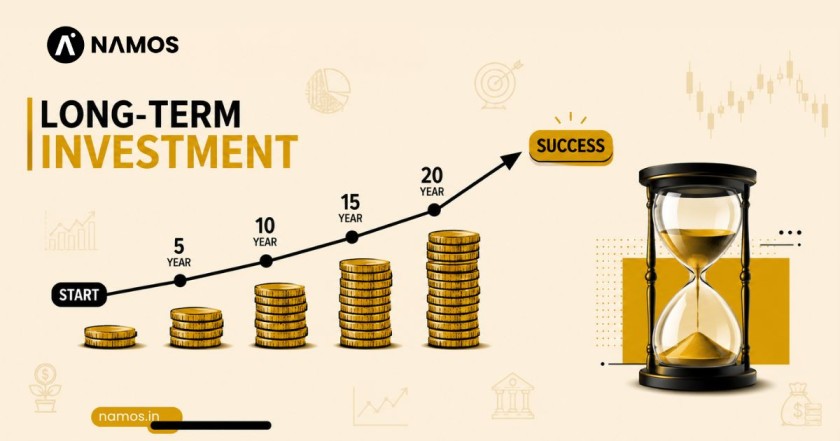
When most people enter the stock market, they focus on one question: “Which stock can give me a quick profit?” But the investors who create real wealth ask a different question: “Which company can continue growing for the next 5, 10, or even 20 years?” That is the difference between Trading and Investing.
Many successful investors, including Warren Buffett, did not become wealthy by buying random stocks every week. They focused on finding great businesses and holding them for a long time. The challenge is that there are thousands of listed companies on the stock market. Some companies look attractive because their share prices are rising, while others may have strong businesses but receive little attention from investors.
So, how do we find the right stock for long-term investment? The answer is simple: we need to study the company from different angles. A good long-term investment is not selected based on a single factor. We need to understand the company’s business, financial health, future growth opportunities, management quality, industry potential, and market perception.
In this guide, I will explain the exact process I use to identify potential long-term investment opportunities. We will look at fundamental analysis, technical analysis, business strength, future demand, and several other important factors that can help investors make better decisions.
By the end of this article, you will have a clear framework to evaluate any stock before investing your hard-earned money.
The Company’s Fundamentals
Before looking at the stock price, charts, or market trends, I always start by understanding the company’s fundamentals.
Think about it this way. If you want to buy a house and keep it for the next 20 years, you would first check the quality of the construction, the location, and the future value of the area. You would not buy it simply because its price increased last week.
The same principle applies to stocks.
When we invest for the long term, we are not buying a ticker symbol. We are buying a piece of a real business. That is why the first question should be: “Is this a strong business?” Fundamental analysis helps us answer that question.
What Should We Check in Fundamental Analysis?
There are several important factors, but these are the ones I consider first:
1. Revenue Growth
Revenue is the money a company earns from selling its products or services. A good company should consistently increase its revenue over time.
For example, if a company’s revenue was:
- ₹1,000 crore in 2021
- ₹1,250 crore in 2022
- ₹1,500 crore in 2023
- ₹1,850 crore in 2024
This shows that the business is growing. As a general rule, I prefer companies that have shown steady revenue growth over the last 3 to 5 years.
2. Profit Growth
Revenue alone is not enough. A company can increase sales but still fail to make money. That is why we must also check profit growth. If both revenue and profit are increasing year after year, it is usually a positive sign that the business is becoming stronger.
3. Debt-to-Equity Ratio
Debt is one of the biggest risks for any company. A company with too much debt may struggle during difficult economic periods.
The Debt-to-Equity Ratio helps us understand how much debt the company is using compared to shareholder capital. In simple terms:
- Lower debt is generally better.
- Very high debt should be investigated carefully.
- Debt-free companies often have more financial flexibility.
For most industries, a Debt-to-Equity Ratio below 1 is generally considered healthy, although this can vary from sector to sector.
4. Return on Equity (ROE)
ROE tells us how efficiently management uses shareholder money to generate profit. A consistently high ROE often indicates a quality business. As a simple guideline:
- Below 10% = Average
- 10% to 15% = Good
- Above 15% = Strong
Always compare ROE with competitors in the same industry.
5. Operating Margin and Net Profit Margin
These metrics show how much profit a company keeps from its revenue. Higher margins often indicate:
- Strong pricing power
- Better efficiency
- Competitive advantage
Companies with improving margins deserve special attention.
6. Understand the Business Model
Start by learning how the company generates revenue.
Ask yourself:
- What products or services does the company sell?
- Who are its customers?
- How does the company make money?
- Is the business easy to understand?
As a long-term investor, I prefer businesses that are simple and easy to understand. If you cannot explain the business to a friend in two minutes, you probably need more research.
7. Management Quality Matters
Even a great business can fail under poor management. Look for management teams that:
- Have a good track record
- Communicate clearly with shareholders
- Make smart capital allocation decisions
- Focus on long-term growth
A good management team can create enormous value over time
Technical Analysis for Long-Term Investors
Many people believe that technical analysis is only useful for traders. However, I also use technical analysis before making a long-term investment. The purpose is not to predict every price movement. Instead, technical analysis helps me answer an important question:
“Is this the right time to invest in this stock?”
Even a great company can become a poor investment if you buy it at the wrong price. That is why I combine technical analysis with fundamental analysis.
My Technical Analysis Process
Once I have shortlisted a company based on fundamentals, business quality, and future growth potential, I open the stock chart.
1. Start with the Monthly Timeframe
The first thing I check is the monthly chart. I use the 30 Moving Average (30 MA) as a trend filter. I ask:
Is the stock trading above the 30 MA?
If the answer is yes, it indicates that the stock is in a long-term uptrend.
If the stock is trading below the 30 MA, I become more cautious because the long-term trend may be weak.
2. Move to the Weekly Timeframe
After confirming the monthly trend, I switch to the weekly chart.
Again, I check whether the stock is trading above the 30 MA.
When both the monthly and weekly charts are above the 30 MA, it suggests that the stock has strong long-term momentum. This increases my confidence in the investment opportunity.
3. Confirm with Volume
Price alone is not enough. Volume tells us whether buyers are supporting the move. I pay special attention to:
- Rising prices with rising volume
- Breakouts supported by strong volume
- Increased activity near important support zones
Strong volume often indicates stronger conviction from market participants.
4. Review the Last 6 to 12 Months
Before investing, I carefully review the stock’s performance over the last 6 to 12 months. I want to understand:
- Has the stock been outperforming the market?
- Is momentum improving?
- Has a new trend started recently?
- Is the stock attracting investor interest?
This helps me identify stocks that are already showing strength rather than weakness.
5. Define the Reward and Risk
Before investing, I always create a plan. I ask myself:
- What is my expected upside?
- Where will I exit if the analysis is wrong?
- How much capital am I willing to risk?
Every investment should have a defined risk.
Setting a Stop Loss
Even long-term investors should think about risk management. If the stock breaks important support levels or the original investment thesis changes, I am willing to exit and protect my capital. The goal is not to be right all the time. The goal is to protect capital and stay invested in strong opportunities.
Tools I Use to Analyze Stocks
Here are the tools I personally use during my research process:
1. Screener
Screener is one of the best platforms for fundamental analysis.
I use it to check:
- Revenue growth
- Profit growth
- Debt-to-Equity Ratio
- ROE
- ROCE
- Promoter holding
- Shareholding pattern
- Financial statements
It is usually the first place I visit when researching a company.
2. TradingView
TradingView is my primary chart analysis platform.

I use it to:
- Analyze Monthly and Weekly trends
- Check the 30 Moving Average
- Draw trendlines
- Identify support and resistance levels
- Study volume activity
This helps me understand the stock’s price behavior before investing.
Making the Final Investment Decision
After completing all the research, I use a simple checklist before investing.
- Find the Stock → Use stock screeners to identify quality companies.
- Check Fundamentals → Analyze revenue growth, profit growth, debt, ROE, ROCE, and cash flow.
- Analyze the Business → Understand how the company makes money and whether it has a competitive advantage.
- Evaluate Management → Check promoter holding, management quality, and corporate governance.
- Use Technical Analysis → Confirm the trend using Monthly and Weekly charts, support/resistance, and volume.
- Assess Risk and Reward → Compare potential upside with possible downside risk.
- Make the Investment Decision → Invest only when fundamentals, business, industry, management, and technicals align.
- Track the Investment → Monitor quarterly results, annual reports, and business performance.
- Stay Patient → Give the business time to grow and let compounding work.
Final Rule
I do not invest because someone on social media recommends a stock.
I do not invest because a stock is trending.
I invest only when the business fundamentals, management, industry, and technical structure all align together.
When multiple factors support the same investment idea, confidence increases and decision-making becomes much easier.
Remember, successful investing is not about finding hundreds of stocks.
It is about finding a few high-quality businesses and giving them enough time to grow.
That is how long-term wealth is created in the stock market.
Disclaimer
The information provided in this article is for educational and informational purposes only. It should not be considered financial, investment, or trading advice.
Stock market investments are subject to market risks, and past performance does not guarantee future results. Always conduct your own research and consult a qualified financial advisor before making any investment decisions.
The author is not responsible for any financial losses resulting from the use of the information presented in this article.
Invest only the amount you can afford to risk, and make investment decisions based on your own financial goals, risk tolerance, and research.