
If you look at the stock market, it may seem very simple – just red and green candles moving up and down, and you think you can make money based on that. But the reality behind the market is completely different.
There are multiple types of traps in the market where both traders and investors often get stuck. These moves are not random—they are driven by smart money, market psychology, and liquidity movements. And remember, this is not controlled by a single person, but by large institutions operating behind the scenes.
Because of this, the market is full of hidden traps. So, in this article, “The Hidden Traps in Stock Market No One Talks About,” we will understand these traps, learn how to identify them, and discover how you can benefit from them.
What is a Trap in Stock Market?
A trap simply means catching someone in a setup—and the same thing happens in the stock market. In the market, traps are created when false signals appear, prices are manipulated, and misleading information is spread through social media and news. All of this is done to create FOMO (fear of missing out) among traders and investors.
When people enter trades based on these false signals and emotions, they get stuck in losing positions. This entire process is what we call a trap in the stock market.
It usually happens when:
- Support & Resistance Levels
- During Breakouts
- High Volatility
- News Time
- Liquidity Zones (Stop-Loss Areas)
- Trend Reversal Points
Types of Traps in the Stock Market
Here are the most common traps every trader should know:
- Bear Trap
- Bull Trap
- Gamma Trap
- Liquidity Trap
- Retail Trap
- Value Trap
- IPO Trap
- Breakout Trap
- Fake News Trap
1. What is Bear Trap?
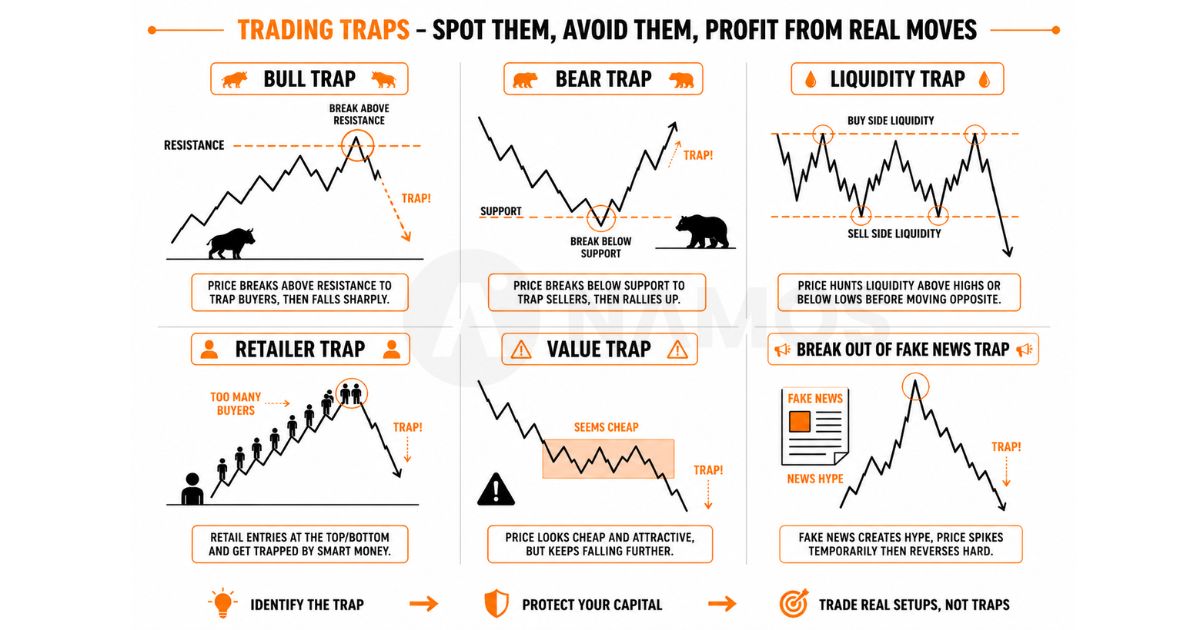
A bear trap forms when the market breaks a key support level. As soon as the support is broken, retail traders assume that the market will continue moving downward, so they enter sell or short positions. They usually place their stop-loss slightly above the breakdown level.
However, instead of continuing downward, the market moves only slightly lower and then quickly reverses upward. This sudden reversal hits the stop-loss of those sellers and forces them out of the market.
This entire setup—where traders are misled into selling and then get trapped—is called a bear trap.
2. What is a Bull Trap?
A bull trap forms when the market breaks a key resistance level or creates a higher high during an uptrend. When this breakout happens, retail traders believe that the market will continue moving upward and create new highs.
Because of this expectation, traders enter buy positions and usually place their stop-loss slightly below the breakout level.
However, instead of continuing upward, the market gives a fake breakout (fakeout) and then quickly reverses downward. This sudden reversal hits the stop-loss of buyers and forces them out of the trade.
This entire setup—where traders are misled into buying and then get trapped—is called a bull trap.
3. What is a Gamma Trap?
A gamma trap forms when the market moves strongly in one direction due to options activity, especially near expiry.
As the price starts moving fast, retail traders think that a strong trend has started, so they enter trades (buy or sell) based on momentum. They usually place their stop-loss nearby.
However, this move is not a real trend—it is happening because big players (market makers) are adjusting their positions (hedging) in the options market.
After some time, when that hedging pressure reduces or changes, the market suddenly slows down or reverses direction. As a result, traders who entered based on momentum get trapped, and their stop-loss gets hit.
This entire setup—where traders are misled by option-driven moves and then get trapped—is called a gamma trap.
4. What is a Liquidity Trap?
A liquidity trap forms when the market moves toward a level where most traders have placed their stop-loss or pending orders.
As the price reaches that area (like support, resistance, or trendline), retail traders think the market will continue in that direction, so they enter trades and place their stop-loss nearby.
However, the market’s main goal is to grab liquidity. So price quickly moves to hit those stop-losses, triggering them. After this liquidity is collected, the market suddenly reverses in the opposite direction.
As a result, traders get stopped out first, and then the market moves in the direction they originally expected.
This entire setup—where price targets stop-loss zones to collect liquidity and then reverse—is called a liquidity trap.
5. What is a Retail Trap?
A retail trap forms when the majority of small traders (retail traders) take the same position based on indicators, news, or social media hype.
When the market looks obvious, retail traders feel confident and enter trades in the same direction, placing their stop-loss nearby.
However, the market often moves in the opposite direction from the majority. Big players take advantage of this situation by moving prices against retail traders.
As a result, most retail traders get trapped, their stop-loss gets hit, and they are forced out of the market. This entire setup—where the crowd follows one direction and the market moves against them—is called a retail trap.
6. What is a Value Trap?
A value trap forms when a stock looks cheap or undervalued, so investors believe it is a good buying opportunity and enter the stock.
They usually think the price will bounce back soon and may hold it for the long term, often without a strict stop-loss.
However, instead of recovering, the stock continues to fall or stays stuck for a long time because the company has weak fundamentals, poor growth, or hidden problems. As a result, investors get stuck in the stock, and their capital remains blocked or turns into a loss.
This entire setup—where a stock looks attractive but keeps underperforming—is called a value trap.
7. What is an IPO Trap?
An IPO trap forms when a new company is about to enter the stock market, and strong hype is created before its listing.
Before the IPO, companies and media generate a lot of awareness through news articles, advertisements, and social media promotion. This information spreads very fast in the market, like fire.
Most retail traders or investors do not have complete knowledge about the company, but due to this hype, a strong FOMO (fear of missing out) is created. Because of this, many people invest in the IPO without proper research.
After the stock gets listed on the exchange, the price may move slightly upward initially, but then it often starts falling. In some cases, the stock is already overvalued at listing, and the price gets corrected later.
As a result, retail investors get trapped at higher levels and face losses.
This entire situation—where hype creates buying pressure and then price falls or corrects—is called an IPO trap.
8. What is a Breakout Trap?
A breakout trap forms when the market breaks an important resistance level or range, making traders believe that a strong upward move has started. As soon as the breakout happens, retail traders think the price will continue to go higher, so they enter buy positions and place their stop-loss slightly below the breakout level.
However, instead of continuing upward, the market gives a fake breakout (fakeout) and quickly comes back below the breakout level. As a result, buyers get trapped, their stop-loss gets hit, and they are forced out of the trade.
This entire setup—where a false breakout misleads traders and then reverses—is called a breakout trap.
9. What is a Fake News Trap?
In the stock market, news usually comes after a move has already happened. By the time news reaches you, the market has often already made its move. At that point, rumors and social media influencers also start spreading information, which may not always be accurate or complete. When this information finally reaches retail traders and investors, a lot has already changed in the market.
Because of this, traders often enter late, leading to overbuying or overselling.
As a result, retail traders and investors get trapped in the market. This is how a fake news trap works—where delayed or misleading information causes traders to make wrong decisions.
9-20 EMA Crossover Strategy Can Change Your Trading Game Forever
How to Avoid Traps in the Stock Market
To stay safe from different types of traps, such as bull traps, bear traps, liquidity traps, retail traps, IPO traps, and fake news traps, traders need to follow a disciplined approach. Here are the key steps:
Always Wait for Confirmation: Never enter a trade immediately after a breakout or breakdown. Wait for candle close, retest, or volume confirmation to avoid fake moves.
Avoid FOMO: Most traps are created due to emotions. If a move already happened, don’t chase it—wait for the next opportunity.
Use Proper Stop-Loss Placement: Don’t place obvious stop-losses at common levels where everyone places them. Use logical levels based on structure, not emotions.
Analyze Multiple Timeframes: Check higher timeframes (4H, Daily, 1hr) before taking trades on lower timeframes. This helps you understand the real trend and avoid false signals.
Stay Away from Hype & News-Based Trading: By the time news reaches you, the move is often over. Avoid trading based only on social media, rumors, or breaking news.
Understand Market Structure: Focus on support, resistance, trend lines, and liquidity zones. This helps you identify where traps are likely to form.
Don’t Follow the Crowd Blindly: If everyone is buying or selling, be cautious. The market often moves against the majority (retail trap).
Focus on Risk Management: Even if you get trapped sometimes, proper risk management will protect you. Never risk more than a small percentage of your capital in one trade.
The Idea Is:
You cannot avoid traps 100%, but you can reduce losses and improve accuracy by following discipline and confirmation.
How to Benefit from Market Traps
Market traps are not only something to avoid; they can also be used as an opportunity if you understand how they work. Instead of entering trades during breakouts or breakdowns, it is better to wait for the false move to happen and then look for a clear reversal. Once the market shows that the breakout was fake and starts moving in the opposite direction, that is where smart traders take entry. These situations often occur near key support and resistance levels or liquidity zones, where stop losses are placed, and the market tends to reverse after grabbing them.
Rather than following the crowd, you should observe where most traders are positioned and think in the opposite direction, because the market usually moves against the majority. It is also important to wait for confirmation through strong candles or price action before entering any trade. At the same time, proper risk management is essential, as no strategy is perfect. In simple terms, instead of getting trapped, you should stay patient, identify the trap, and trade the reversal to benefit from it.